My primary goal is to provide outstanding service to the citizens of St. Johns County while creating a tax roll that is fair, equitable and accurate. Should your interaction with our office and our team not meet or exceed your customer service expectations, please contact me.
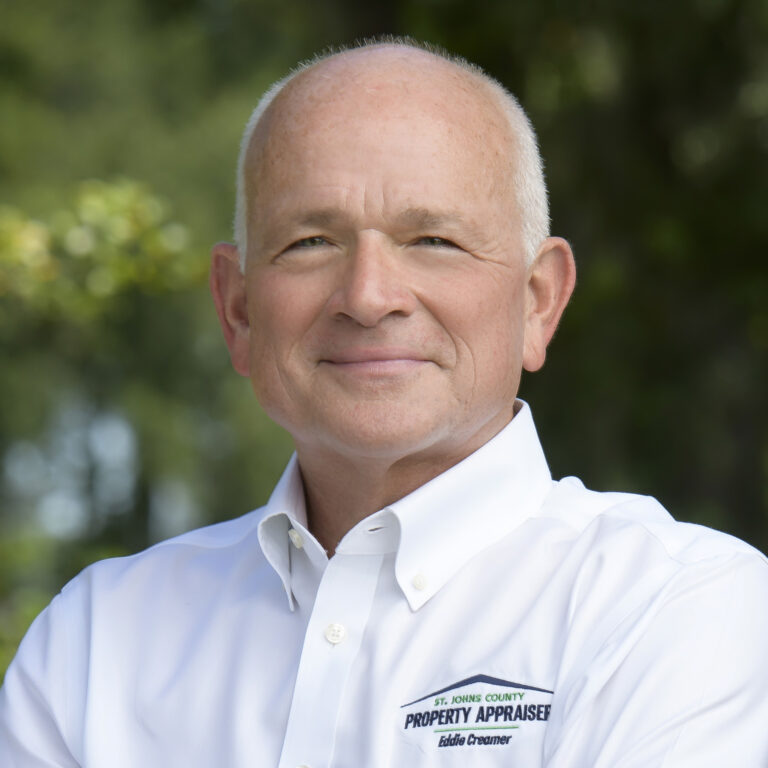
St. Johns County Property Appraiser Eddie Creamer has led the St. Johns County Property Appraiser’s Office since 2017. With a current team of 49 employees, Eddie and his staff appraise more than 181,000 parcels of real and tangible property valued at $90 billion and administer more than 115,000 personal exemptions.
Eddie began his third term in office in January 2025. In his first two terms, Eddie focused on process improvements, technology advancements, and cost-saving initiatives with the goal of providing cost savings to St. Johns County residents. During that time, he managed the implementation of annual high-resolution aerial photography, bi-annual ultra-high-resolution street level imagery and change detection software. He also revamped the website to offer the convenience of applying for exemptions online and added other helpful services as well. The outcomes of these initiatives facilitated more desktop appraisals versus field time, increased staff productivity, reduced safety risks, minimized resident inconvenience and saved taxpayers more than $500,000 per year.
In this next term, Eddie will continue to put an emphasis on those initiatives while also remaining diligent in providing outstanding customer service to the community. He is actively engaged in educating the community about the latest updates within the industry and within the St. Johns County Property Appraiser’s Office. He regularly meets with community groups, realtor offices, title companies and more to share the most up-to-date news and information.
Eddie believes in elevating transparency in government. He publishes the working tax roll in real time on the office’s website so that property owners can see their property’s current values, exemptions and caps along with the TRIM notice and tax bill at all times. Also, he has implemented adding department budgets, monthly financial reports and audit results on the website.
Eddie advocates for the taxpayer. He is supportive of measures that lower property taxes for residents. Presently, Eddie is advocating for improvements to senior exemptions by recommending an increase in the income and property value limits to help ease the property tax burden for seniors.
His current membership affiliations include the International Association of Assessing Officers (IAAO) and the Property Appraisers’ Association of Florida (PAAF). He serves on the PAAF Legislative Committee and Florida Department of Revenue CFE Certifications Committee. He earned the Certified Florida Appraiser Designation (CFA) where he successfully completed 160 hours of classroom instruction and exams combined with two years of experience. Eddie serves as Chairman of the St. Johns County Audit and Insurance Committees as well.
In 2022, the St. Johns County Property Appraiser’s Office led by Eddie was awarded the Certificate of Excellence in Assessment Administration by the International Association of Assessing Officers (IAAO), the profession’s highest authority. The St. Johns County Property Appraiser’s Office is one of only 60 jurisdictions to have received this prestigious award nationally. This is the highest professional honor an assessment jurisdiction can obtain.
Before being elected as the St. Johns County Property Appraiser, Eddie was the Regional President of Ameris Bank and formerly the CEO of Prosperity Bank. During his nearly 35 years in banking, Eddie led his team to elevate customer service and quality, drive technological advancements, increase profitability and expand product offerings. While at the bank, Eddie also sponsored and supported many community organizations and events. Eddie’s banking knowledge and background in accounting are beneficial in his current role as the St. Johns County Property Appraiser.
Originally from Port St. Joe, Florida, Eddie and his wife, Julie, have made St. Johns County their home for the last 28 years. They have two adult sons, John and Daniel. Outside of work, Eddie treasures time spent with his family. As a baseball enthusiast, Eddie also enjoys traveling to baseball games throughout the country and has made it his goal to visit every Major League Baseball stadium in the United States.